Grab a blanket and watch the show!!!!!

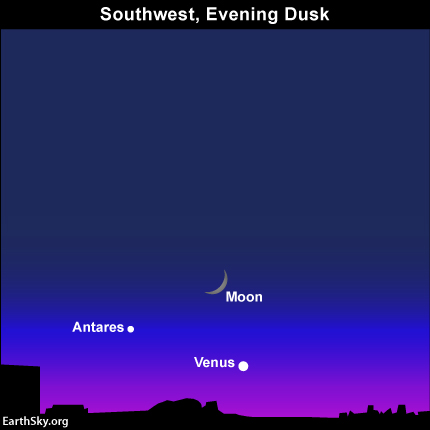
The first thing you want to do after sunset tonight, is to catch the waxing crescent moon and the planet Venus low in the west-southwest sky. The moon sets first and Venus sets next, but both are long gone by the time that Taurus fully climbs over the eastern horizon at mid-evening.
Setting time of the sun, moon and Venus in your sky
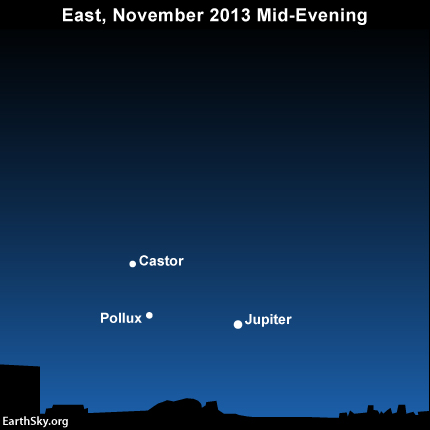
The planet Jupiter and the Gemini stars, Castor and Pollux, rise above the horizon somewhere around 9 to 10 p.m. local time at mid-northern latitudes.

The constellation Leo the Lion and the red planet Mars rise over the eastern horizon in the wee hours between midnight and dawn.
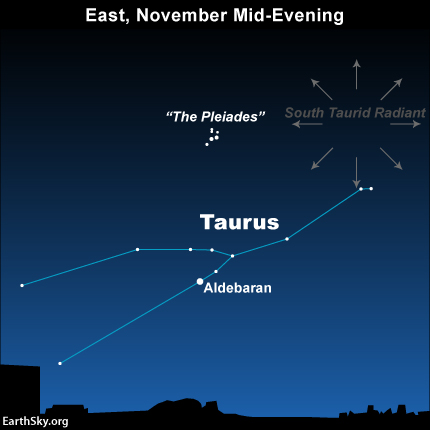
The South Taurid meteor shower is expected to be at its best from late evening on Monday, November 4, till dawn on Tuesday, November 5. This shower greatly favors the Northern Hemisphere, but the best viewing from anywhere worldwide is usually during the wee hours just after midnight. Best yet, there will be no moonlight to ruin the South Taurid tonight!
The other Taurid shower – the North Taurids – should add a few more meteors to the mix. The forecast calls for the North Taurid shower to be raining down the most meteors a week or so after the South Taurid peak, on the night of November 11/12. But the moon will exhibit a bright waxing gibbous phase, adding a lot of light to the sky.
As a general rule, the Taurid showers do not exhibit strong peaks. The two Taurid showers tend to overlap and to plateau in activity during the first few weeks in November. On any given night, these rather slow-moving meteors produce the greatest numbers in the few hours after midnight, perhaps up to 10 meteors per hour. Although a modest shower, the Taurids can surprise you with a flamboyant fireball or two!
The radiant points for these two November meteor showers – the South Taurids and North Taurids – are both in the constellation Taurus the Bull. If you trace the paths of shower meteors backward, you’ll find the meteors appear to radiate from a distinct point in the starry sky. As can be expected, the radiant point for the South Taurids is found in southern Taurus, while that of the North Taurids is found in northern Taurus.
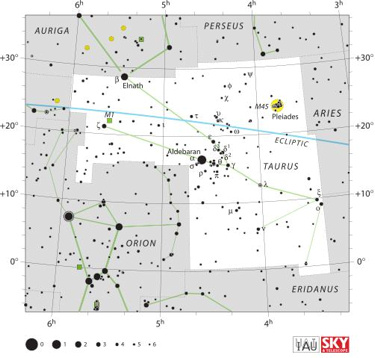
Taurus the Bull – the Taurid showers’ radiant point – climbs upward during the evening hours and reaches its highest point in the sky after midnight. As a rule of thumb, the higher that Taurus appears in your sky, the more Taurid meteors that are likely to fly. Taurus itself is full of interesting things to see such as the Pleiades star cluster, the V-shaped Hyades cluster with bright Aldebaran in its midst.
The three stars of Orion
Click here for a larger chart.
EarthSky’s meteor shower guide for 2013
You don’t need to find Taurus to watch the Taurid shower, for these meteors streak all over the sky.
Bottom line: Watch the South Taurid meteor shower show its stuff in early November 2013. Because the Taurids are known for putting out bright fireballs, you may see one or two on a dark November night.
On a more Somber Note....We've lost two members of our small community

Frank L. Casey
December 16, 1919 - November 3, 2013
Place of Birth: Georgia, Cave Spring

Silver Star - Awarded for actions during the World War II
The President of the United States of America, authorized by Act of Congress July 9, 1918, takes pleasure in presenting the Silver Star to Captain (Air Corps), [then First Lieutenant and Second Lieutenant] Frank L. Casey, United States Army Air Forces, for gallantry in action while serving as First Pilot and Element Lead Pilot on heavy bombardment operations of the EIGHTH Air Force over Continental Europe from 8 May 1944 to 16 January 1945. Participating in an exceptionally large number of hazardous missions during this period, Captain Casey consistently exhibited courage, skill, and gallantry of the highest order. Returning from a mission 8 January 1945 in heavy weather, he brought his aircraft across the channel on two engines only to experience the loss of all power upon reaching the coast. Displaying dexterity and airmanship seldom witnessed, he accomplished a "dead stick", "wheels up" landing without injury to any member of the crew. Captain Casey's disregard for personal safety, tenacity of purpose, and devotion to duty, were a constant source of inspiration and served as an incentive for his fellow flyers to strive for greater accomplishments. The courage, flying skill, and unyielding fighting spirit displayed by Captain Casey are in keeping with the finest traditions of the Army Air Forces.
General Orders: Headquarters, 8th Air Force, General Orders No. 101 (June 26, 1945)
Action Date: May 8, 1944 - January 16, 1945
Service: Army Air Forces
Rank: Captain
Division: 8th Air Force

Distinguished Flying Cross - Awarded for actions during the World War II
The President of the United States of America, authorized by Act of Congress, July 2, 1926, takes pleasure in presenting the Distinguished Flying Cross to First Lieutenant (Air Corps) Frank L. Casey, United States Army Air Forces, for extraordinary achievement while participating in aerial flight while serving as a Pilot of a B-17 airplane on many heavy bombardment missions over German occupied Continental Europe during World War II. Lieutenant Casey's marked professional aptitude in the handling of his aircraft and capable leadership as airplane commander aided in the successful destruction of many enemy military objectives. The courage, coolness and skill displayed by Lieutenant Casey on all these occasions reflect the highest credit upon himself and the Military Forces of the United States.
General Orders: Headquarters, 3d Bombardment Division (H), General Orders No. 449 (August 15, 1944)
Action Date: World War II
Service: Army Air Forces
Rank: First Lieutenant
Regiment: 3d Bombardment Division (H)
Division: 8th Air Force
Distinguished Flying Cross - Awarded for actions during the World War II
Captain (Air Corps) Frank L. Casey ), United States Army Air Forces, was awarded a Bronze Oak Leaf Cluster in lieu of a Second Award of the Distinguished Flying Cross for extraordinary achievement while participating in aerial flight during World War II.
Action Date: World War II
Service: Army Air Forces
Rank: Captain










Recent Comments